BRU · ALDANE SYSTEM · 7.9 LY FROM MENHIR

Brumara

Every station's last log ends mid-sentence.

WENT SILENT · DAY 10 OF THE QUIET

SCROLL

At a glance

Type Ice world
Star Aldane, a distant white star; long pale days
Day length 52 hours
Climate −40 °C average; constant light snow; whiteouts; still nights
Location 7.9 ly from Menhir · 22.5 ly from the Meridian Gate
Went silent Day 10 of the Quiet
Peak population 38,000 (scientific staff)
Survey status Open: Stations Alpha to Kestrel

History

Brumara was never a home. It was a laboratory: a chain of research stations studying the ice sheet, which is 9 km deep, and what lies beneath it. Stations are modular brutalist blocks on stilts, linked by heated covered walkways and served by tracked crawlers and a single mountain railway. The deep-ice programme, Project Undertow, was the Reach's most expensive science project. Its results were never published.

Environment & biome

Gravity 1.08 g
Atmosphere Thin nitrogen-oxygen; too low-pressure and cold to breathe unaided, so rebreathers are required outdoors
Temperature −40 °C average; −70 °C on the long nights
Terrain A continental ice sheet up to 9 km thick, sealing a liquid ocean beneath, kept from freezing by geothermal heat from the planet's core; jagged nunatak mountains along the Aldane range
Sky Aldane is small, white and sharp; ice crystals paint halos and sundogs around it. The upper atmosphere glows neon pink: a faint airglow that never fully fades, seen as a pink band low along the horizon and bleeding into the fog. On rare clear nights it rises into pink aurora curtains. Most of the time the sky is cold blue haze
Heat and orbit Orbits far out from hot, bright Aldane, near the cold edge of its habitable zone, so the surface freezes while the core keeps the deep ocean liquid. No moons.
Weather Constant light snow (crystals forming out of clear air); sudden whiteouts; cold katabatic winds pouring off the mountains

Biome: life under the ice. On the surface, almost nothing lives: just frost lichen, rust-orange crusts on exposed ridges that grow a millimetre a century. The real biome is hidden. Microbes frozen in ice cores suggested the subglacial ocean below was alive, and it's what Project Undertow was drilling towards. Its findings were never published.

Hazards: whiteouts, crevasses hidden under fresh snow, cold that kills in minutes without a suit.

After the Quiet

Architecture

Survive the cold, stay modular, raise everything off the ice. Institute architects designed for engineers in gloves: nothing beautiful, everything repairable.

Materials Dark graphite composite over insulated panels (dark hulls soak up Aldane's weak light for warmth); concrete footings drilled into rock and ice; steel stilts; triple-glazed window bands.
Forms Heavy brutalist blocks and modules, raised on stilts or built into rock, with cantilevered observation decks; heated covered walkways; low domes for observatories; lattice drill towers and relay masts.
Windows and light Neon pink, everywhere. The builders lit every station in the same vivid pink as the sky: window strips, walkway lights, greenhouse domes, the beacons on every mast. Partly practical (pink is unmistakable against snow in a whiteout, and the greenhouses' grow lights glow that colour anyway), partly morale: the scientists said it made the stations feel like part of the sky rather than intruders under it. White floodlights for work only.
Interiors Labs, bunk rooms and greenhouse modules under pink grow lights; mess halls with steamed-up windows; notes pinned to the walls; coffee cups left half-finished.
After 50 years Snow drifted up to the second floor and walkways frosted solid, but icicles of meltwater hang under every heater outlet: the heating never stopped.
Building type Notes
Station block Modular research and living blocks on stilts; a station is 4–12 of them.
Covered walkway Insulated tubes on stilts linking every block, so nobody has to go outside.
Drill tower Steel lattice towers over boreholes, the tallest reaching 120 m at the Undertow Shaft.
Observatory dome Low concrete domes on ridges, watching Aldane and the pink aurora.

Places

Vessels

Built by: Aldane Institute. Science first. Institute vessels were modular, insulated and easy to repair in the field with gloves on. If a part could freeze, it was wrapped; if it could break, it was bolted on the outside where it could be reached.

Silhouette Compact and sturdy: boxy, rounded-edge modules joined in a short chain, stubby wings, sturdy landing legs or tracked skids. 40–150 m.
Hull White quilted thermal cladding over pale grey frames, like a padded jacket; thin ice-blue stripes along module seams; no logos.
Lights Neon pink light from small, deep-set cabin windows; white floodlights under the hull; tiny pink navigation lights.
Details External sample pods, a folded drill boom, sensor masts and antenna arrays, frost and small icicles along every edge, snow on every upper surface.
Interior glimpse Cramped labs: benches, sealed sample cases, a coffee cup, all lit neon pink.
After 50 years Half-buried in snow drifts, a crust of frost on the cladding, but a melted ring around each heater vent: the heaters are still running.
Vessel type Notes
Undertow-class research vessel Long-range lab ship for deep-drill work, and the exception to the boxy Institute look: one long quilted barrel, about 150 m. Undertow II is one.
Ice crawler-lander A tracked lander that drives across the ice sheet between stations.
Courier hopper A small, fast, two-seat shuttle for moving samples between stations.

Ground vehicles

On Brumara, vehicles are shelters that happen to move. Every one carries heat, air and food for a week, because a whiteout can strand you anywhere.

Look Boxy and rugged: white quilted thermal cladding, wide tracks, roof-mounted antennas, external storage pods, everything bolted on the outside.
Lights Big white floodlights and pink roof beacons; neon pink cabin windows; small pink position lights.
After 50 years Half-buried in drifts, but with a melted ring of slush around each one: the heaters are still running. Halfway up the mountains, the Aldane Line train sits halted, cabin lights on.
Vehicle type Notes
Ice crawler A tracked, insulated station-on-treads for six researchers; drives between stations for days.
Snow buggy A small two-seat tracked runabout for short trips around a station.
Aldane Line train A single mountain railway: three insulated carriages and a snowplough engine.

Sound

Standing alone in a snowfield so quiet you can hear the snow land. Wonder, with a chill underneath.

The worlds of the Reach are all tuned to the Hum, the note A. Brumara sings it in lydian.

Surveys

1 of 6 known properties surveyed

Station Kestrel, BrumaraREC · SV-31▶ Watch the survey
OWR-BRU-0010 · Kestrel Peak

Station Kestrel

Surveyor
SV-31
Length
One local hour
Recorded
4 Nov 2311
Status
Listed

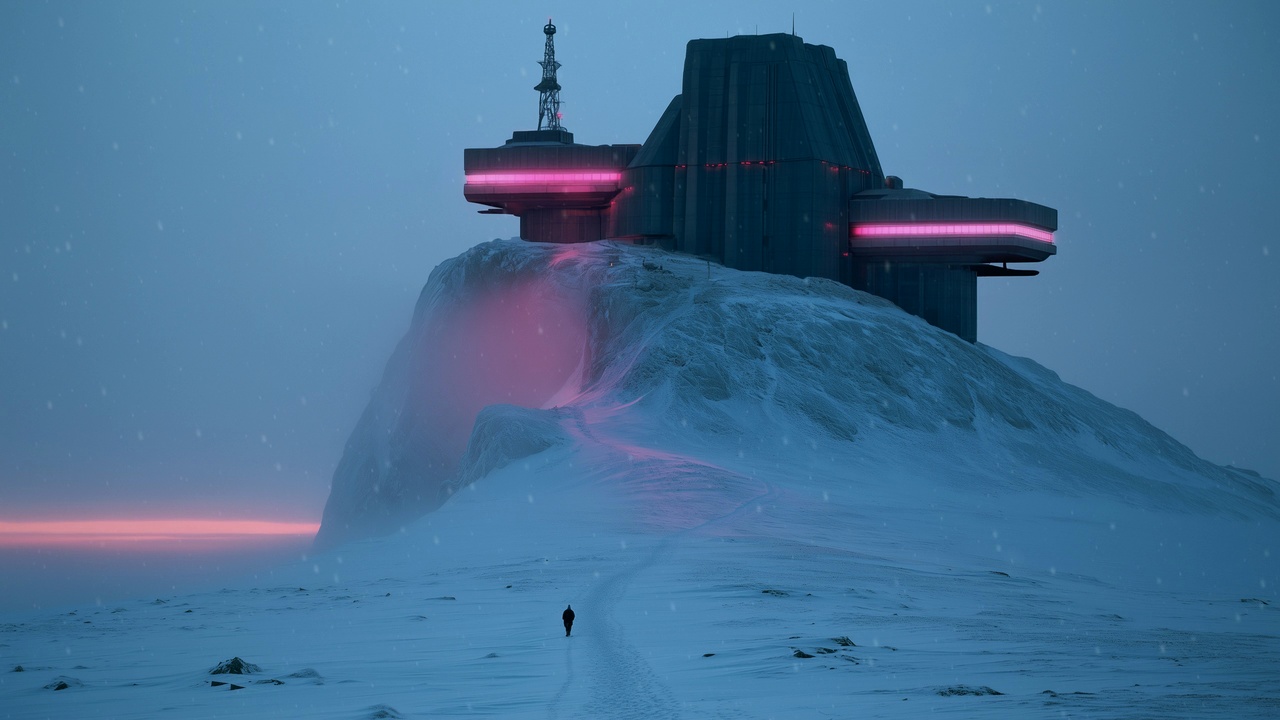
The last station in the chain. Station Kestrel sits on the summit of a lone peak at the edge of the ice sheet, the outermost of the Institute's stations, named for a bird that perches high and watches. A massive dark graphite block grips the rock, with observation decks cantilevered out over the cliffs and every window band glowing neon pink. Fifty years after the Quiet, the heating still runs. And one set of footprints leaves the lower airlock, heading north across the snow. They don't come back, and no snowfall has ever covered them.

Full site record
Built 2209, by the Brumara Institute, as the chain's atmospheric observatory and relay to the far ice
Elevation Summit 1,900 m above the ice sheet
Crew 46 at its peak
The decks Two cantilevered observation decks, one facing the ice sheet, one facing the open north
The tunnel A lift tunnel through the rock connects the summit to the lower airlock. Its mouth still spills pink light onto the slope
The mast The relay antenna on the roof. Its single red warning light is the only light on Brumara that isn't pink: Institute air-traffic rules
The footprints One set, leaving the lower airlock heading north. Fifty years of snowfall have never covered them
Telemetry (SV-31) Air temperature −41 °C. Ice beneath the peak: 9.2 km. Station heating: active
Survey position SV-31, hovering low over the snowfield south of the peak, facing the station

Today: every window band still glows pink, icicles hang under every heater outlet, and the footprints are as sharp as the day they were made.

Surveyor noteFootprints leave the lower airlock heading north. Fresh snowfall has not covered them.

Awaiting survey
  • Undertow
  • Aldane Line
  • Crawler Field 2
  • The Pod
  • Station Alpha Observatory

From an Outer World Realty brochure: "Pristine. Peaceful. Perfectly preserved."