MEN · LUME SYSTEM · CENTRE OF THE REACH

Menhir

They were here before us.

WENT SILENT · DAY 0 OF THE QUIET

SCROLL

At a glance

Type Moon of the gas giant Orun
Star Lume; light filtered through permanent fog; Orun hangs fixed in the sky
Day length 6 days (tidally locked to Orun)
Climate Cold, windless, near-total fog; sound carries strangely
Location Centre of the Hollow Reach · 18.7 ly from the Meridian Gate
Went silent Day 0 of the Quiet
Peak population 4,000 (heritage authority and pilgrims)
Survey status Restricted: the Outer Field only

History

When the first settlers reached Menhir, the monoliths were already there: hundreds of smooth, dark structures, some over a kilometre tall, arranged in lines across the plains. They were not built by humans, and no one knows who did build them. The Accord declared Menhir a heritage site and built a small settlement, the Waystation, to study and protect them. The Hum was first recorded on Menhir, in 2238. Pilgrims came to stand beside the monoliths and listen.

Environment & biome

Gravity 0.61 g (part of why the monoliths can stand so tall)
Atmosphere Thin, cold, slightly oxygen-poor; breathable with a light supplement
Temperature −5 to 4 °C, almost constant
Terrain Flat dark basalt plains covered by shallow meltwater pools, so the ground is always wet and reflective; the monolith lines run for hundreds of kilometres
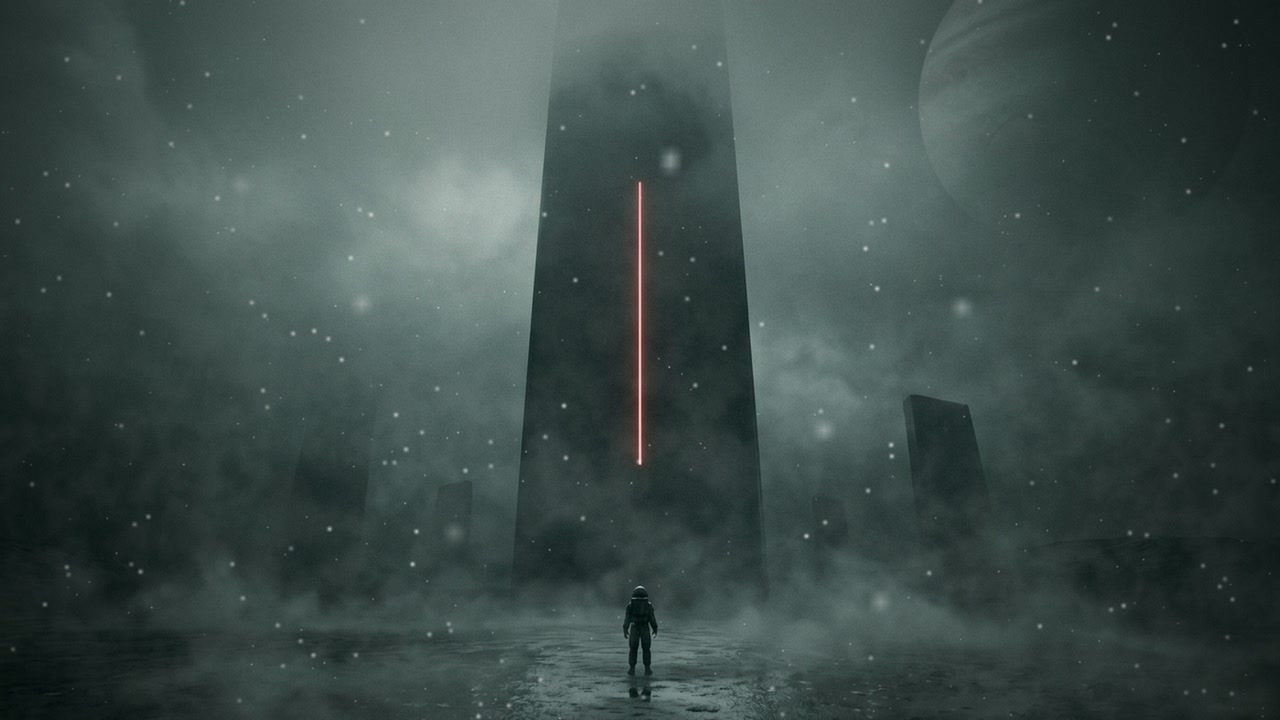
Sky Orun, a ringed gas giant, hangs fixed in the sky (Menhir is tidally locked). It spans about 10° (roughly twenty full Moons side by side), and its rings, seen almost edge-on, stretch a thin bright line more than twice as wide; Lume's pale orange light barely reaches through the fog
Heat and orbit Warmed partly by distant Lume and partly by tidal heating: Orun's gravity flexes Menhir's crust, melting the shallow pools that feed the fog. Tidally locked, so one face always looks towards Orun. Once every orbit, Orun eclipses Lume for a few hours: the dark hour, when the fog goes black and only the red line on the Great Monolith is visible.
Weather Near-total fog from the cold pools; almost no wind; sound travels unusually far and seems to come from the wrong direction

Biome: the shadow moss. Menhir has one known native organism: a grey moss that grows only in the monoliths' shadows. The moss forms perfect rings and lines, and its growth pattern matches the monoliths' alignment. It stopped growing on Day 0, and in 2304 surveyors found it growing again, outwards.

Hazards: disorientation in the fog; compasses fail within a kilometre of a monolith; prolonged exposure to the Hum causes headaches and vivid dreams (per Waystation medical logs).

After the Quiet

Architecture

Never compete with the stones. The Heritage Authority's rule: build low, quiet and humble, and nothing taller than ten metres within sight of a monolith. Human buildings on Menhir were designed to look like they might be taken away tomorrow.

Materials Pale grey poured concrete, slate roofs, plain glass, stone-paved paths.
Forms Low single-storey pavilions, long open shelters and terraces, often half-sunk into the ground so they disappear into the plain.
Windows and light Long, low window strips; soft white light only. The single exception is a small red marker light on every shelter.
Interiors Benches facing the monoliths, bare walls, a shelf of lamps by the door.
The monoliths Not human-built. Smooth, seamless and dark, with no joins, marks or texture; up to 1.2 km tall; arranged in perfectly straight lines. Since the Quiet, a thin red line of light runs down the Great Monolith.
After 50 years Untouched and beaded with fog. At Pilgrim's Rest, the lamps are still lit.
Building type Notes
The Waystation The one exception. Out of sight of the stones, so the rules didn't apply: a seamless, almost alien port grown out of a basalt cliff, modelled on the monoliths themselves (see Survey sites).
Pilgrim shelter Open-sided concrete shelters every few kilometres along the paths, each with a bench and a lamp.
Listening terrace A wide, shallow stepped terrace facing a monolith, built for gatherings of the Listeners.
Heritage marker Waist-high concrete posts marking the paths, each with a small red light.

Places

Vessels

Built by: Accord Heritage Authority (public). Humility. Heritage Authority vessels were designed not to compete with the stones: plain, quiet and respectful. Pilgrims said the transports looked like the monoliths' smaller, younger cousins. Nobody at the Authority admitted that was intended.

Silhouette A long, low, faceted prism with a flat underside, sharply chamfered edges and almost no protrusions, like a carved block. 80–200 m.
Hull Matte stone-grey ceramic, slate to fog-grey, with no shine, no panel lines visible from a distance, and no markings.
Lights One thin horizontal strip of soft white cabin windows along the side; a single small red navigation light. Nothing else.
Details A plain boarding ramp lowered to the ground, fog beading on the hull, its reflection in the wet basalt below.
Interior glimpse Through the window strip: rows of plain seats facing forward, as if waiting for a sermon.
After 50 years Untouched. Beaded with fog, ramp still down, every seat empty and every reservation still valid.
Vessel type Notes
Pilgrim transport Carries 400+ pilgrims from the Gate to the Waystation's Field. Long Listening is one.
Waystation shuttle A small version of the same design, for staff and supplies.
Heritage skiff A two-person survey craft that hovers silently along the monolith lines.

Ground vehicles

The Heritage Authority banned motor vehicles from the Outer Field. Pilgrims walked, sometimes for days, along stone paths between the monolith lines. Only silent hover skiffs were allowed, and only for staff.

Look Barely there: flat, matte stone-grey slabs that float silently just above the ground, a seat and a low glass screen, no visible engine.
Lights A single small red light, the same as the pilgrim transports. Nothing else.
After 50 years Skiffs parked in a neat row at the edge of the Outer Field, beaded with fog. The pilgrims' paths are still visible, worn smooth into the basalt by centuries of feet. Nobody has walked them since Day 0.
Vehicle type Notes
Heritage skiff A silent, low-hovering slab for two staff, used to inspect the monolith lines.
Waystation hauler A slightly larger hovering platform for supplies, used only around the settlement.
On foot The pilgrim's way: stone paths, rest shelters every few kilometres, and a long walk to the Great Monolith.

Sound

Standing before something older than humanity. Awe, stillness, a sense of being watched kindly or otherwise.

The worlds of the Reach are all tuned to the Hum, the note A. Menhir sings it in open fifths.

Surveys

2 of 6 known properties surveyed

The Great Monolith, MenhirREC · SV-10▶ Watch the survey
OWR-MEN-0007 · The Outer Field

The Great Monolith

Surveyor
SV-10
Length
One local hour
Recorded
31 Oct 2311
Status
Listed

At the far end of the Outer Field, where the longest line of monoliths ends, stands the tallest of them all: 1.2 kilometres of smooth dark stone rising straight out of the wet basalt and vanishing into the fog long before its top. Pilgrims walked two days along the Pilgrim's Way to stand in front of it. Since the Quiet, a single thin line of red light has run down its face.

Full site record

Like every monolith it has no joins, no marks and no texture, and no instrument has ever found an inside. Four hundred metres in front of it lies the Listening Stage, the shallow stone terrace where the Listeners gathered, sat in silence with the Hum, and sometimes sang along. It was the place on Menhir where the Hum was loudest. One bench is still there, at the front.

Height 1.2 km, the tallest known monolith
Footprint About 140 by 60 metres: a slab, not a tower, facing the Listening Stage
Age Unknown. No weathering, no erosion; dust and moss never settle on it
Surface temperature Always exactly the same as the air around it
The red line About 380 m long, down the centre of its face. Not there before 2261; first recorded by a Quarantine probe in 2263. It gives off no heat, and nothing on the surface produces it
Nearest structure The Listening Stage, 400 m away
Survey position SV-10, hovering above the Listening Stage, facing the monolith

Today: the fog moves around it but never seems to touch it. The bench on the Listening Stage is beaded with water. Nothing else on the Outer Field has changed since Day 0.

Surveyor noteLow-frequency readings outside calibrated range.

Waystation, MenhirREC · SV-10▶ Watch the survey
OWR-MEN-0008 · The Ledge

Waystation

Surveyor
SV-10
Length
Three local hours
Recorded
1 Nov 2311
Status
Listed

The only way in. Every pilgrim, scientist and supply crate that ever reached Menhir came down here first: a spaceport that seems to grow out of a black basalt cliff high above the sea of fog, forty kilometres from the Outer Field and far out of sight of the monoliths. It is the one place where the Heritage Authority's ten-metre rule didn't apply, so it's the only large thing humans ever built on Menhir, and it looks almost alien.

Full site record

Why it looks this way. The Authority's architects spent decades studying the monoliths before they designed it, and it shows. Like the stones, the Waystation has no joins, no seams and no visible structure: its pale stone-ceramic was grown in place, so the building pours down the cliff face in long flowing curves, as if the rock had melted into it. There are no ordinary windows; cool white light glows from within thin seams in the material. Pilgrims called it the stones' pale echo. The Authority never confirmed that was the intention.

From the air it reads as one continuous form: tall curved fins rising up the cliff, sweeping terraces, and three landing platforms that open out over the drop like petals, each rimmed with small white guide lights. A Waystation shuttle still rests on the largest, lowest one. On the clifftop stands a sculpted beacon spire with a single slow red light. Below, the sea of fog stretches to the horizon, and far away hangs Orun, small and hazy, its rings a thin bright line.

Part What it was
The Petals Three landing platforms opening out from the cliff. The Upper and Middle Petals took skiffs and the supply hauler; the broad Lower Petal took shuttles. A shuttle is still on it.
The Field The flat landing ground on the plateau above, for the big pilgrim transports. Long Listening is still there.
The Arrival Hall Behind the long curved band of light above the Upper Petal. Every pilgrim was registered here and given a lamp and a paper map (compasses fail near the stones).
The Infirmary In the lowest sweep of the building, beside the start of the Way. Pilgrims were checked going out and coming back, so its logs are the best record of what the Hum did to people.
Dormitories Inside the tall fins: rooms for pilgrims before and after the two-day walk, and quarters for about sixty Heritage Authority staff.
The Records Hall Deep inside the rock: every monolith survey, and every recording of the Hum since 2238.
The Beacon A slender spire twisting up from the clifftop with a single red light, so ships could find the Ledge above the fog.
The Pilgrim's Way Begins as a narrow path cut along the cliff face, lit by tiny red marker lights, winding down through the fog to the plain and on towards the stones.
Survey position SV-10, hovering off the Ledge above the sea of fog, facing the port

Today: every seam of light is still glowing, and the beacon still pulses. The shuttle on the Lower Petal has fog beaded on its hull. The lamp shelf in the Arrival Hall is full: nobody set out on the Way that morning. The infirmary's final log entry is dated Day 0, 06:38.

Surveyor noteSettlement lights on. Final medical log entry, Day 0, 06:38: "No headaches reported today."

Awaiting survey
  • The Listening Stage
  • Orunrise
  • The Line
  • Pilgrim's Rest

From an Outer World Realty brochure: "Ancient heritage site. Exclusive, quiet, timeless."